

Liquidity Pool Mining Tutorial: How to Participate in LP Mining Guide
Liquidity Pool (LP) Mining Tutorial
Part 1: What is LP Mining?
LP mining (Liquidity Pool Mining) or Defi Liquidity Mining Pool is a mechanism in decentralized finance (DeFi) that allows users to earn trading fee returns by providing liquidity to decentralized exchanges (DEX). Decentralized exchanges replace the traditional order book model with liquidity pools. Users need to deposit two assets in equal value proportions (e.g., 50% BNB and 50% USDT) into the pool to obtain LP tokens (liquidity certificates). These LP tokens represent the user's share in the pool and can be used to claim trading fee returns (typically 0.1%-0.3% of the trading volume).
Part 2: Participating in LP Mining to Earn Returns and Adjusting LP Ranges
TokenPocket wallet has launched an LP mining section, allowing users to directly access LP mining features by scrolling down on the discovery page. The following uses PancakeSwap's ZKJ/USDT pool as an example to briefly describe the steps for participating in LP mining to earn returns and adjusting LP ranges.
1. How to Earn Liquidity Mining Returns
- Open TokenPocket wallet, go to the discovery page, and click on the "Explore" section.
- Find the "Binance Alpha LP Mining Section", click to enter, and select PancakeSwap's ZKJ/USDT pool.
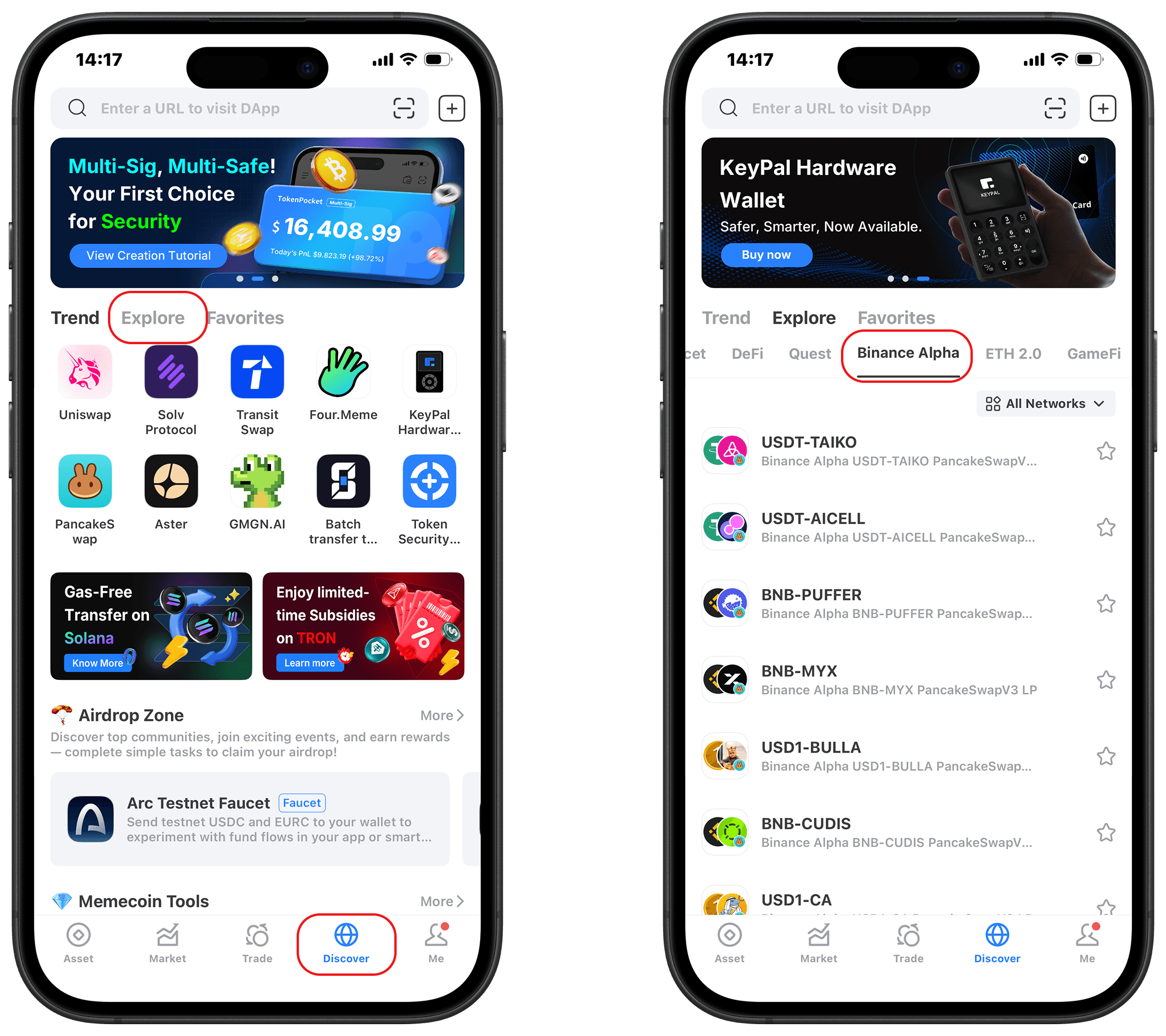
- Add liquidity: On the mining section interface, select the ZKJ/USDT trading pair
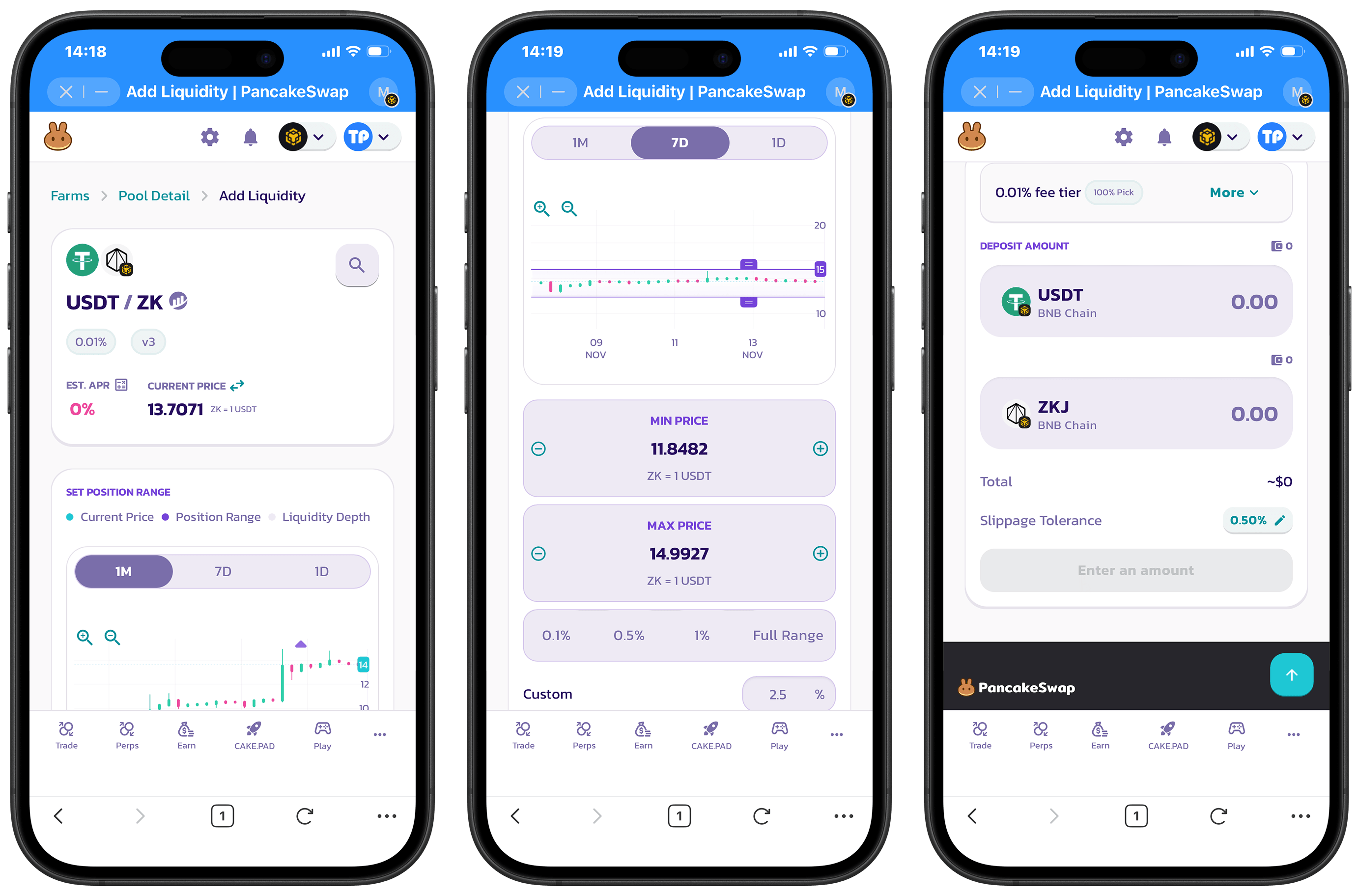
- Select Price Range: In TokenPocket "DApp-Explore", enter the Binance Alpha mining section, select the PancakeSwap ZKJ/USDT pool. Click "Add Liquidity", set a narrow price range (e.g., current price ±0.5%, example 0.995 - 1.005).
- Enter Amount: Enter equal value amounts (e.g., $100 ZKJ and $100 USDT), confirm, pay BSC Gas fees, and receive LP tokens.
- Check Returns: On the mining section or PancakeSwap "Liquidity" page, view LP tokens and trading fee returns. Check the "Analytics" page for APY, or use BscScan to track returns.
2. How to Adjust LP Range
On PancakeSwap V3, the ZKJ/USDT pool allows setting price ranges. When the market price is within this range, funds earn more trading fees; if it exceeds the range, there are no returns.
- On the "Liquidity" page, find your LP position, click "Remove Liquidity" to withdraw funds.
- Click "Add Liquidity" again, select ZKJ/USDT, set a new price range, and confirm the transaction. Adjustments require paying Gas fees.
Optimization Strategies:
- Prioritize high-volume pools (such as ZKJ/USDT) for stable returns.
- Regularly check APY and market prices through the mining section. If prices go out of range or returns decrease, withdraw liquidity or adjust to more active ranges.
- Pay attention to Gas fees (BSC is lower, Ethereum is higher). Wider ranges can reduce out-of-range risks but may result in lower returns.
Part 3: Impermanent Loss
1. What is Impermanent Loss?
Impermanent Loss in liquidity mining is a potential loss in LP mining. When the prices of the two assets in the pool change, the user's asset value may be lower than directly holding these assets. Simply put, liquidity pools automatically adjust asset ratios to maintain equal values, causing your asset portfolio to potentially favor assets with falling prices, thus "losing" value.
-
Example
Suppose you are providing liquidity for the ETH/USDT trading pair, investing 1 ETH (worth $100) and 100 USDT, with a total value of $200. The pool requires the two assets to maintain a 50:50 value ratio. If the ETH price rises to $200, the pool will automatically reduce the ETH quantity and increase the USDT quantity through arbitrageurs' trades to maintain balance. When redeeming, your total asset value may be lower than the current value of directly holding 1 ETH and 100 USDT. This difference is impermanent loss. If the price returns to the initial level, the loss may disappear, hence the term "impermanent".
Summary: Impermanent loss occurs due to price volatility. The greater the volatility, the greater the loss. Low-volatility trading pairs can reduce impermanent loss.
Part 4: Risks of LP Mining
While LP mining is attractive, risks need to be carefully considered:
- Impermanent Loss: Price volatility may cause asset value to decrease, offsetting trading fee returns. Stablecoin pairs like BUSD/USDT have lower risks.
- Market Risk: Declining trading volume may reduce trading fee returns.
- Smart Contract Risk: DEX smart contracts may have vulnerabilities.
- Gas Fees: BSC network Gas fees are lower, but frequent operations still need to consider costs.
FAQs about Liquidity Ming
1. What is the best liquidity pool?
The "best" pool is highly dependent on your personal risk tolerance, the specific asset pairing, and your investment goals.
Key factors to consider:
- Yield (APR/APY): Higher returns often mean higher risk.
- Liquidity: Pools with high total value locked (TVL) generally offer better trading stability.
- Impermanent Loss Risk: Stablecoin-to-stablecoin pools (e.g., USDT/USDC) have the lowest IL risk, while volatile pairs have the highest.
- Platform Security: Choose well-audited and established decentralized exchanges (DEXs) like Uniswap, Curve, or Balancer.
2. Is liquidity mining risky?
Yes, liquidity mining carries significant risks. It is generally considered a high-risk investment.
Primary Risks:
- Impermanent Loss (IL): The potential loss incurred when the price ratio of your deposited tokens changes, compared to simply holding them in your wallet.
- Smart Contract Vulnerabilities: The underlying code (smart contract) can have bugs or exploits that lead to the total loss of deposited funds.
- "Rug Pulls": Malicious project teams can suddenly drain the liquidity pool and disappear.
- Token Price Volatility: The tokens you earn as rewards or the tokens you deposited may suffer rapid price drops.
3. Can you withdraw from a liquidity pool?
Yes, you can withdraw your funds (remove liquidity) at any time. Liquidity pools are designed to be non-custodial and allow for flexibility.
Withdrawal Process:
- Go to the "Liquidity" or "Pool" section of the specific platform (DEX) where you made the deposit.
- Select your active liquidity position.
- Choose the "Remove" or "Withdraw" option.
You will receive your proportional share of the original tokens (plus any accumulated fees, adjusted for impermanent loss) back into your connected wallet.
Conclusion
Participating in PancakeSwap's LP mining (such as the ZKJ/USDT pool) through TokenPocket's mining section is a convenient way to earn trading fees. PancakeSwap V3 supports custom price ranges, allowing users to optimize capital efficiency. Users need to choose high-volume pools, regularly check returns and flexibly adjust LP ranges, while being vigilant about impermanent loss and potential risks. It is recommended that beginners prioritize stablecoin pairs, and after familiarizing themselves with the mechanism, try trading pairs with greater volatility or concentrated liquidity strategies. Before participating, please fully research market dynamics and assess your own risk tolerance.
Disclaimer
Investing in and using cryptocurrencies involves market, legal, and technical risks. Proceed with caution. Always keep your mnemonic phrase and private keys secure and never share them with anyone. This article is for informational purposes only and does not constitute investment advice. Before using any wallet, do your own research and ensure compliance with local laws and regulations.